Saturday, 7 April 2018

Debriefing #BMCE9

So this week I had the pleasure of attending #BCME9 (pronounced BiC ME) at the University of Warwick.  The conference happens once every four years and I was incredibly fortunate that my school paid for my attendance along with a very generous bursary from the SMC, again thank you so much.

I left snowy Inverness on Monday for the conference to begin on Tuesday.  Once the conference started it was full on for 4 days.  I've got pages and pages of notes and I've definitely added a few things to my to do list.  I want to use this blog post to record my biggest takeaways from the conference.

My absolute highlight from the conference was a lecture from Prof Berinderjeet Kaur from the National Institute of Education in Singapore titled 'How the Mastery Approach Works in Singapore.  What can UK Teachers Adopt or Adapt?'.  Her talk was informative and inspiring - I came out of the talk prepared to pack my bags and move to Singapore but then she said that they have a surplus of teachers (I know you read that right - a SURPLUS!!!!!).  In her lecture Prof Kaur shared the framework for Maths teaching in Singapore.
Related image


Her explanation of the framework was perfection.  All maths teaching rests on a base of concepts but equally significant is the skills and processes.  Then the teaching is fortified by attitudes and metacognition.  She did admit that the metacognition was still an area that needed development. And that the core was Mathematical Problem Solving.  My absolute favourite image that Prof Kaur shared was the following image.  Borrowed from a tweet from Richard Perring (@LearningMaths).  What an incredible way to show the addition of integers.
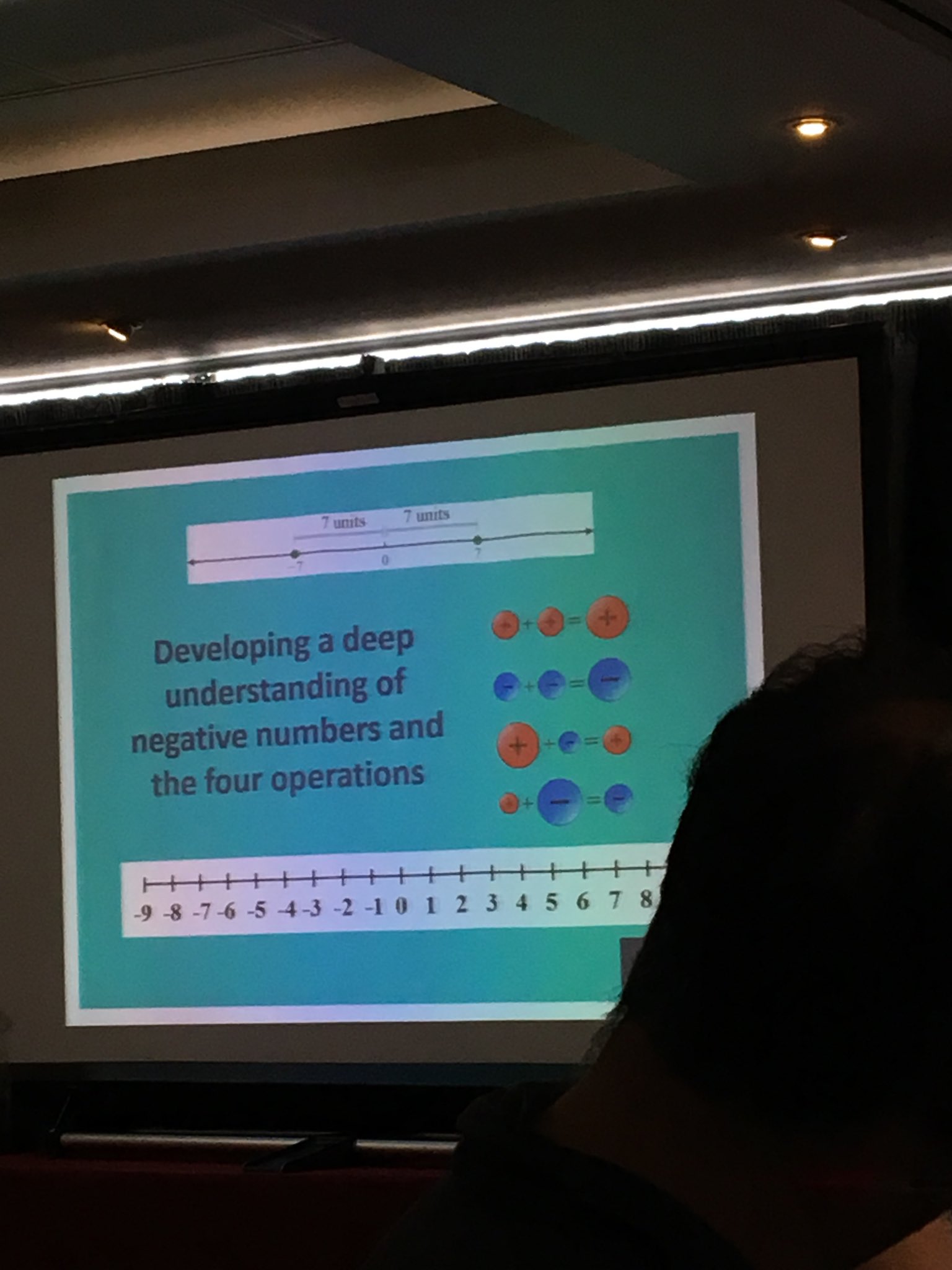


Prof Kaur got her biggest reaction when she told the room that all Singapore teachers are entitled to 100 hours of CPD funded by the Ministry of Education - 100 HOURS!!!!!!  Also all teaching materials and manipulatives are provided by the Ministry of Education so every school has the same resources.  Imagine what an impact it would have if all schools in Scotland had exactly the same resources irrespective of catchment.  I could go on more and more about this talk but I won't.  I am extremely excited to talk about it with my department though.

Anyone who follows me on Twitter knows that I am a major fangirl for Craig Barton so I snapped up the chance to hear him talk alongside Andrew Taylor of the AQA with a workshop entitled 'Why exams do not tell you what students actually know'.  Having listened to his podcast I had heard a lot of what he said before - however hearing it and seeing it makes a huge difference to your understanding.  Craig went into significant detail on what his lessons look like and there was so much food for thought.  I certainly will be sharing the Example - Problem Pairs strategy with the department now that I have had the opportunity to see what it looks like in practice.

I also grabbed the opportunity to hear Jo Morgan speak on Ideas that Transformed My Teaching.  I particularly enjoyed the portion of her workshop on Methods.  I have spend quite a lot of time this session looking at effective teaching strategies and methods to use with pupils to maximise understanding so it was great to hear someone talking about this as well as sharing methods she used that had not been so successful.

My final workshop was 'Investigating Mathematical Attainment & Progress' By Colin Foster and Jeremy Hodgen which was a research presentation.  There were a lot of takeaways from this session.  The first being that effective teaching strategies are also effective for low attaining pupils - we do not have to change our teaching.  From interviews with pupils there is a desire from them for processes to be explicit or easy but once they have been shown, they really want the opportunity to do it for themselves.  Also things that we assume are obvious are not obvious to our pupils but if we tell them and point it out to them and they are shown it explicitly they might actually see it and therefore be able to use it.

I learned so much over the four days.  I am so going to #BCME10 and hopefully I'll have a crew of Scots to invade the conference with.  Maybe we should put on a workshop?????

Wednesday, 8 November 2017

Mrs P Pilfers (1)

One area of my practice that I'm not very good at is writing resources.  I would much rather find something already written and tweak it for my needs.  Nothing serves this purpose better than a regenerating worksheet on Excel (other spreadsheet programmes are available).  During a recent scour of the mathsnet, I came across these absolute nuggets.  They are from the South Yorkshire Maths Hub and it's their Rainbow Arithmetic Materials.  There are starter questions in a whole range of difficulties as well as an adaptable worksheet covering all the levels available in the starter questions workbook.  The resources can be found here.

Within the department we are currently using them as starters for S3 and S4.  These worksheets cover a lot of the non calculator skills required by our N4 and N5 candidates and it is historically a weak area we're trying to address year on year.  Pupils are really responding to them and are slowly working their way through the levels.


Until my next pilfering session.

Sunday, 15 October 2017

Reading in Threes (1)

I want to start a 'regular' feature on the blog - three blog posts/articles that I've read.  I don't know how frequently these posts will come but I'm hoping they will help me to write more frequently and also allow me to keep a nice record of what I've been reading.  I am also in need of a name for this series of posts.


I really liked this post from Mark Enser - The Ritual of Teaching
In this post Mark discusses some practices in classrooms, how these have become a required element of all lessons in some schools and advocates for teachers to practice in their classrooms what they know to work.


This is also a great one from Ben Newmark - Ten Principles for Great Explicit Teaching
Here Ben chronicles his journey to improve his teaching through explicit instruction.  This is not a maths specific post but this is definitely a post worth reading for an insight into making explicit teaching work as effectively as possible.  It has also been very kindly illustrated by Oliver Caviglioli.


I really like Tom Sherrington's blog and this post - Principles of Effective Teaching is a good one.
Tom outlines 12 principles for effective teaching and briefly explains them.  I especially like what he has to say about behaviour, teaching to the top and planning.  He references a few lists collated by other sources and then gives his own research free and driven by his gut.


Some extras:

The NCETM have just published their Secondary Mastery assessments and there are some nice questions in there.


If you haven't already you should check out the Teacher Tapp app.  


Every day at 3.30 the app notifies you to answer three questions.  The purpose of which is to gather information about teachers, their working conditions and what they spend their time doing.  As a 'reward' for answering their three questions, the app shares the results from the previous day and gives you a 'tip' which is normally in the form of a quick blog post or article to read.  I have certainly read some very enjoyable and informative posts through the app.

Wednesday, 4 October 2017

Some Things I'm Struggling with

This year I have a new post.  I am a Maths Development Officer based in my school.  My remit includes but is not limited to developing our new BGE course with the hopes that it seamlessly feeds into senior phase; researching, observing and sharing best practice in maths teaching; developing relationships with parents to help support pupils in maths; diagnostic assessment and intervention teaching with S1 pupils and analysing data to measure impact.  As well as those duties I am also teaching two S1 classes who are in mixed ability sets.

I have been working my way through the S1 year group performing diagnostic assessments and they have shown in video what the department and I knew was going on for some of these pupils.  Where I am really struggling is how do we ensure in a mixed ability class, where whole class teaching is the method of delivery, that we accommodate the needs of pupils who are in Early level right up to those pupils who are very secure at level 2 and ready for the challenge of level 3 (if they haven't already accessed parts of level 3)?  I'm not sure if I'm writing this post as a rhetorical and next year I'll be able to write a post and talk about the progress we made or if I'm looking for someone to give me the answer.  We do have intervention lessons in place for these pupils, so I guess the next thing I'm struggling with is how to make the best of these intervention sessions so that they have impact?  I'm not naive enough to believe intervention lessons can make up for being 3+ years behind where they should be but I need them to close that gap.

If anyone can help me, either by offering a school visit or general advice I'd love to hear from you.  I will set myself a reminder for in a years time to revisit this post and update on our progress.


Thursday, 28 September 2017

Preserving a Memory

I am writing this blog post so that I can always remember this conversation that I had with a pupil.  I want to remember it for two reasons: what this pupil said to me resonated so much with my experiences as a pupil and also left me deeply touched.

The pupil in question is applying to study maths at university with the intention of becoming a maths teacher.  We were discussing her UCAS application, teacher training and encouraging positive attitudes towards maths.  During this conversation she told me she wanted to come back and work in our school.  When I asked her why, she replied with 'I know what difference a good teacher makes and a school like this needs teachers like that'.  As a former pupil of the same school, I know exactly what she was talking about.  I had an incredible maths teacher and she really sparked my love of maths.  My life may have taken a very different direction had it not been for her.  Great teachers really make the difference for young people and their life choices.

When I left my school as a pupil I thought my journey at the school was over and I wouldn't ever be back but 6 years later there I was, this time as a teacher.  After this conversation and many other like it, I know exactly why I came back...for kids like her.  I've taught her for 3 years and during that time she has really blossomed as a mathematician.  I know it could have happened with any other teacher but it is a privilege to be a part of that.  There is something magical about the kids I work with.  I also know lots of other teacher's experience similar relationships with pupils but I think we always think there is something special about our kids...just like parents.  All I know for sure is the relationships I form with pupils are 50% of why I love my job.  The other 50% is getting to talk about maths all day.

Friday, 15 September 2017

#MathsWeekScotland Round Up

Today concludes Maths Week Scotland for my school.  And boy did we have a busy week.

On Monday, the Numeracy and STEM Prefect Team organised an after school scavenger hunt for S4 - 6 pupils. Using problems from the UKMT maths challenges, Chris Smith's maths newsletter and other bits and pieces they put together a loop around the school.  The first team with a correct loop won some prizes but all the participants were treated to pizza.  The numbers were small which the prefect team felt was quite manageable but everyone had a good time.  The prefects pitched the problems at a good level and every team was able to make their way round the loop.

On Tuesday, the S1 - 3 pupils were treated to a Fun Maths Roadshow.  Twenty five maths problems were placed around our concourse and pupils had to work in pairs to solve them before moving on to another one.  I was also incredibly delighted to get some parent volunteers to come in and assist with the roadshow.  Comments from the pupils have been very positive about the roadshow with the S3 year group complaining when I told them that they're time was up.  Music to a maths teachers ears - pupils complaining when it's time to finish doing maths.  It's amazing what you can learn about pupils when you take them out a classroom setting.  One pupil in particular spent almost the whole two hour session on one puzzle because he was determined to get it.  In the classroom, he is very quick to give up.  Moving forward, I will use this to encourage him in his maths education.

On Thursday, the S4 - 6 pupils had a visit and presentation from two local companies, CRC Evans Offshore and Ross-shire Engineering.  Both of these companies came to speak to the pupils about the importance of maths in their workplaces.  A lot of what they had to say I'm sure will stick with a lot of pupils.  What stuck with me was the following:

  • Employers may not need their employees to be able to carry out calculations but they must understand what the conclusions of these calculations mean and how to respond to them
  • During business meetings, the inability to carry out on the spot calculations undermines a business partner or clients confidence in your abilities particularly in negotiations.
  • Pythagoras and Trigonometry are used by some engineers on an almost daily basis.


Thursday also saw the first ever Parents' Puzzle Night at Alness.  Parents were treated to some classic puzzles and brain teasers along with cake.  In advance of this event, I created a powerpoint and then parents were given whiteboards so they didn't have to worry about making mistakes.  I know that some pupils will definitely be getting some puzzles to do at home from their parents now, especially since Mum and Dad can show off that they know the answers.  It was a nice informal evening with some unexpected senior pupil guests (apparently they were not happy that parents were getting all of the fun).  There is some work to be done on raising the profile of this event but I am positive that next year it could be bigger and better.

Over the past few weeks, I have been slowly adding some videos on to the school Facebook page to support parents who want to help with maths and numeracy at home.  The video I put up for Maths Week is quite a long one on Mental Calculation and Multiple Strategies.  Thankfully I had some keen S2 pupils to help with this one and their nerves didn't get the better of them.  I'm going to add to this one with a video of how we use the technique in the classroom to hopefully show parents how they can complement what we do in school at home.

I'm not going to lie, Maths Week has been exhausting but in the loveliest way.  Seeing enthusiasm for maths in our pupils makes it all worth it.  And maybe we will have changed some attitudes towards maths or maybe not, but our department got to showcase their love and passion of maths and take the rest of the school along with them for one week at least.  That is a win for me.

Tuesday, 22 August 2017

#MathsConf12 Reflections

I'm so delighted to finally be reflecting on a MathsConf.  Hopefully, it is the first of many.  This past Saturday I had the delight of attending and presenting at MathsConf12 in Dunfermline.  An excellent addition to the Scottish maths conference calendar.  I went to three excellent sessions and delivered a very intimate workshop myself on 'My Best of Twitter and Other Online Finds'.  I will attempt to recap the day and provide my own reflections and hopefully how I'm going to change my practice.

The day started with a welcome from Mark McCourt (@Emaths) followed by a speed dating session.  It was lovely to get to share resources with other practitioners and discuss teaching practice in an intimate setting.  I certainly got some things to think about using in my own teaching.

Next were the workshops  

The first session I attended was with the lovely Darren McKinnon (@dazmck) on '10 Things Every Maths Teacher Should Know'.  The workshop was an excellent balance of ethos, research and practice.  Darren's 10 are as follows plus my interpretation of what he was saying (which in advance will be flawed, sorry for butchering it Darren!)

1. We, not You
A teachers and their class are a team.  It is much more empowering for pupils if they know you are along for the ride with them and you are as invested in their success as they are.  Language is the key to developing those vital relationships with pupils.

2. The Curse of Knowledge
As teachers, we know what we know.  We know how everything all makes sense and links together as Darren was saying - we know the tune.  When we initially teach something all our pupils are hearing is a series of taps - they have no idea what we song we are singing.  We have to be so careful when teaching that we are not asking pupils to learn a whole song rather than it's individual parts.  I loved this analogy as it is so logical, how could you argue with it.

3. Memory is the Residue of Thought
Of course, Daniel Willingham got a mention in here.  We need to plan lessons what for our pupils will think about because that is what they will remember and learn and that's why 'active' lessons where pupils are having 'fun' don't lead us to the success we think it should.  Our pupils are thinking about the wrong thing. Being successful is fun for pupils, if we make them better at maths they will find the 'fun' in it.  Is fun really what we're looking for though?  Is it not motivation to be better?  And does that not come from being successful in learning what you're supposed to be learning?

4. Cognitive Activation Strategies
What Active Learning should have been called so that people in education wouldn't think it means getting kids out of their seats.  We're talking about highly effective teaching practices that make pupils think and not dancing around a room or making paper aeroplanes so that we can calculate the speed at which they fly.

5. Cognitive Load Theory
I can't even attempt to distill what Darren was trying to put across here without sounding like a complete know nothing but my general gist is that we must be mindful of how much of our pupils' working memories is taken up carrying out tasks that should be more automatic for them and as such make it incredibly difficult for them to fully grasp any new content.  For more reading on Cognitive Load, Greg Ashman's Blog is an excellent place to start or Craig Barton's (@MrBartonMaths) podcast with him is an excellent introduction.

6. We need to take planning seriously
We need to give up planning for a single lesson and instead plan a series of lessons.  Only over time will we know whether or not pupils have learnt anything or not.  One lesson is not a good indication of learning.  Again, further reading can be done at Kris Boulton's Blog

7. Beware Shortcuts 
Nix the Tricks got a nice wee plug here but it's message still needs to be spread.  We shouldn't teach tricks just to make sure a pupil can do something.  We need them to know why.

8. The Benefits of Low Stakes Testing
I'll go into more depth on this one since it was my second workshop further down.

9. Stop Worshipping Past Papers
My favourite quote of the day came from this portion of Darren's workshop. 'The level of analysis we do on past papers is only useful if we plan on giving pupils the exact same past paper'.  Our pupils need to be better prepared for any question and not just ones that have been similar to previous exams.  If all of the drama around N5 has taught us anything is that pupils and teachers are relying too much on past papers and not thoroughly learning the content.

10. We're Never Done
We can and should all do better.  We should expect more from our pupils.  We should not dumb down our explanations to make it easier for pupils.  They should know what a numerator and a denominator is.  If they can learn the name of chemical elements and and the different types of cloud they can use proper mathematical language.

Overall, very thought provoking and definitely leads me to some additional reading.

My second workshop was with Neil Tilston (@MrTilstonMaths) and his session on Low Stakes Assessment.  This is something that I introduced to Higher and N5 towards the end of the session last year and I really felt that it made a huge difference to pupil's overall attainment.  I was very interested to hear how Neil was using it as it is a very different approach.  First off, Neil has been using these assessments consistently with classes across the year, a four question test every week.  He plans single topic assessments on work that the class have not covered in a few weeks.  He records the scores for pupils, hands back the tests and goes over it.  He makes sure that pupils are aware that it is a test for them, whether they do well or not so well, the reaction from him will be the same - 'here's your test back'.  After a few weeks he has a wealth of data on pupils that allow him to accurately complete tracking and monitoring reports, raise any concerns about pupil attainment and plan follow up homeworks and further tests.  This is something I would like to roll our across our department so hopefully after hearing Neil talk, I'll be able to convince more in the department that it would be beneficial.  Already, I know how I plan to change my practice following this session.

Due to a technical problem with my laptop, I wasn't able to participate in the TweetUp - next time for sure.  My workshop followed after lunch so I needed to make sure I was set up for that.

My final workshop of the day was with the fabulous Chris Smith (@aap03102).  Chris is Scotland's own little comedy mathematician and musician.  Again, he delivered a fabulous workshop on all the wonders he has purchased from EBay and uses in his classroom.  Personal favourites were the multiplication monkey and the unhelpful calculator.  With all the stuff he brought though, I'm surprised he has room to fit his kids into his classroom.  It wouldn't be a Chris Smith session without a sing song so we ended with a parody of Backstreet Boys 'I want it that way' fittingly titled I bought it on EBay.  A fun way to end an excellent day.

I thoroughly enjoyed the day.  All the time that was planned for attendees to chat was very much appreciated and seeing some familiar faces made the day even better.  Bring on #MathsConf17.